To begin ...

As the twentieth century fades out
the nineteenth begins
.......................................again
it is as if nothing happened
though those who lived it thought
that everything was happening
enough to name a world for & a time
to hold it in your hand
unlimited.......the last delusion
like the perfect mask of death

Showing posts sorted by date for query sacred sites. Sort by relevance Show all posts

Thursday, February 1, 2018

Susan Suntree: from “Sacred Sites, The Secret History of Southern California” with a foreword by Gary Snyder


Book Two: The Origins of Southern California: Indigenous Myths and Songs
Part 1: Universe, World, People

First

                       
                        there is

quiet.

           
            Only solitude

                                   
                                       like an empty house          (no house)
                                               
                                                                                               
Only


Kvish Atakvish

                        Kvish: Vacant

                        Atakvish: Empty

                       
                                    These two are man and woman, brother and sister.


Then Kvish Atakvish

becomes

Omai Yamai

                        Omai: Not Alive

                        Yamai: Not in Existence


When these two discover themselves,
they talk with one another:
                                                                         
           
            Brother, who are you?
           
            Sister, who are you?
                                                            (Desire stirs the man,
                                                            so he never again calls her sister.)


            She asks again: Who are you?


            He says:
           
                        Kvish

                        Kvish

                        Kvish
                                                            I am     Empty
                                                             
                                                                        Empty

                                                                        Empty
           

            He blows out his spirit breath:    Hannnn!


            She answers:

                        Atakvish

                        Atakvish

                        Atakvish
                                                            I am     Vacant

                                                                        Vacant

                                                                        Vacant
           

            She blows out her spirit breath:   Hannnn!


            She asks again: Who are you?

            He answers:
                       
                        Omai

                        Omai

                        Omai
                                                            I am     Not Alive

                                                                        Not Alive

                                                                        Not Alive


            He blows out his spirit breath:     Hannnn!


            He asks again: Who are you?

            She answers:
                       
                        Yamai

                        Yamai

                        Yamai
                       
                                                             I am    Not in Existence

                                                                        Not in Existence

                                                                        Not in Existence

           
            She blows out her spirit breath:    Hannnn!


                                     Not Alive-Not in Existence
                                                  
                                                   becomes

                                    Whaikut Piwkut  Harurai Chatuta


                        Whaikut Piwkut: Pale Gray   The Milky Way    

                        Harurai Chatutai: Changing   Descending Deep into the Heart     


                                                These two become


                        Tukmit: Dark Sky                       Tomaiyowit: Earth.
                                   

(Clearly it is not
            male and female                       
            sky and earth,
                        but of another nature.)


These two:

Tukmit   Tomaiyowit    Dark Sky  Earth

                                                come forth from what came before
not as children
but as themselves:
                        a Continuing Being.

                        It is very dark
                                                without stars, sun, moon.

The woman lies with her feet to the north.

The man sits by her right side.

In the darkness
                        they talk with one another again,
                        and what they name
                        they become:

                                                            The First World.

[NOTE & FOREWORD.  The full range of Suntree’s work (University of Nebraska Press, 2010), not shown here, is in fact an epic including both indigenous & scientific/geological views of myth & history in an unprecedented way.  This is no small accomplishment – in fact a really great one – to which attention is called here.  
            Of her book’s major status, unless we miss it, Gary Snyder writes by way of Foreword:
            ”A work of great spirit accomplished with patience and vision, Susan Suntree’s epic poem is a lovely weaving of science and myth. It is a work that sings. Like all good stories it reads like the storyteller is right there, speaking to the reader, shaping the universe one song at a time.
           “Suntree’s book is about impermanence. From the very beginning, the landscape known as Southern California has reshaped itself dramatically and often. Learning how a place comes into being acquaints us with forces of life that are large and intimately interconnected. For the indigenous people, the creation and transformation of the world is an account of the First People. In this way of looking at it, the land is alive and working out its own story. 
           “Conditions are always changing. Something always upsets the balance. Suntree recounts a pivotal moment in one of the creation myths when Frog Woman and her cronies curse the great leader Wiyot, bringing death into the world. The First People respond by sitting together and talking things over until they find ways to accommodate changed conditions and rebalance the world. The common good is at stake. Everybody participates: trees, animals, weather, and eventually the human beings.  So this is a book about maintaining balance. We can only do this by carefully listening to our non-human neighbors and relatives.
           “But people resist letting the world in. We tend to think of the natural, the sacred, the wild as happening outside our neighborhoods and far away. Suntree brings us home. Every day in Los Angeles, tectonic plates, weather blown in from thousands of miles away, and the work of Raven and Coyote are always at play. Don’t miss it!
           “Suntree’s many years of writing, performing, and activism inform her work. So it is in part her cumulative wisdom and insight that makes this book so strong. Here we have a model for a much larger project: indigenous and Western poets and scientists swapping stories, singing their best songs around the same fire, working hard to keep the world in balance. That is going to take every song we’ve got.”]
Tuesday, March 8, 2016

Jeffrey Angles: A Translator’s note on the 2010 Kumamoto Renshi (Linked Poetry) Session


Sunday 15 August 2010
Toward a new appreciation of the collaborative

During the romantic era, the notion that individuality represented the source of all new developments in the art world came to have enormous cultural influence in the West. Rather than seeing poets, writers, visual artists, composers and performers as temporally bound people working within (and often against) the bounds of their own cultures and prison-houses of language to produce their work, the romantic era tended to view artists as visionaries who dove into the depths of their individuality to present new, personal works that spoke of their vision of the world. It is no wonder then that the figure of the genius – a person who was seen as possessing an distinctive personality and mind that presented them with idiosyncratic visions different from those of everyone else’s – grew to figure so prominently in romantic concepts of art, music and literature.

Even now, in the early twenty-first century, the romantic notion of art, with its ideas of singular authorship and vision, continues to have a great pull over our contemporary imaginations. Perhaps nowhere is this more apparent than in the acclaim given to individual producers of so-called ‘high culture’. It is common to praise people as great authors, artists and poets – even geniuses – while forgetting that what we call ‘greatness’ is not just the result of natural skill and vision, but also hard work, learning, practice and honed craftsmanship. The flip side of this respect for the individual artist is that our society tends to place less value on artistic products born out of cooperative acts of creation. For instance, commercial publishers tend to shy away from co-authored books, and academia, at least in the United States, tends to place less weight upon co-authored books or (even worse) translations. In the visual art market, people assume, a piece of art is less interesting and valuable if it is not the sole product of a single individual. It is precisely for this reason that agents behind many commercially successfully visual artists who do rely on helpers tend to gloss over this fact in marketing. (For instance, it is common to see exhibitions of Dale Chihuly, Jeff Koons or Takashi Murakami which do not even mention the fact that each of these artists hands off their ideas to crews of loyal workers who execute them.)

Still, when one stops to think, what pieces of art are not collaborative in nature? Architecture requires not just an architect, but engineers and labourers to produce. Cinema involves not just a director and actors, but often casts of hundreds, if not thousands of others. Music involves a collaborative effort between composer and performers, even though sometimes they might live hundreds of years apart. Artists often rely upon advice and help of technicians, friends, or fellow artists, and even when they do not, it is still the gallery or museum curator who determines the ways an artistic work is seen and the value bestowed upon it. Writing usually involves intimate collaborations with editors. Not only do they do much of the final shaping of contents; in the end, editors are the ones who determine what exactly will be seen by the world. In addition, postmodern theory has, at least in the academy, started to change the ways people see the relationship between the individualism and art. Focusing on the flow of ideas and power relationships that structure a work, poststructuralism emphasises those aspects of creative acts that are beyond the control of the individual creator. If anything, the creator is only one focus within a network of historical and linguistic forces – one operation within the parameters of complex semiotic systems that predate the artist him- or herself.

If art is necessarily collaborative, then perhaps it is incumbent upon us to shift radically the ways that we think about ownership in the linguistic and visual arts. Perhaps it would make sense for us, as readers and consumers of culture, to celebrate collaboration between poets, novelists, translators, visual artists, musicians and performers. Perhaps it would make sense for us to seek out genres of artistic production that highlight and celebrate collaboration, not just because they present us with exciting, fresh flows of ideas, but also because they do the important work of unsettling traditional, conservative notions of intellectual proprietorship and truth.

Renshi as collaborative poetry 

The argument above is a roundabout way of arguing for the value of collaborative poetic endeavours. Poetry has been a field that has been especially prone to the romantic cult of individuality, no doubt in large part due to the ideal that the poet represents a sort of ‘seer’. (In fact, this idea of poet-as-seer has roots at least as far back as Greek thought, but certainly, it took on new force in the romantic era.) Nonetheless, we should not allow this to eclipse our appreciation for other kinds of poetry that has been created through interesting and innovative forms of collaboration, especially considering how important such collaborations has been in the history of poetry around the world.

One of the most exciting, dynamic forms of contemporary collaborative poetic production today is renshi or “linked poetry” – the modern offshoot of a far older verse form known as renga (“linked songs”), which was popular in medieval and early modern Japan. In renga, poets would cooperate to write poems with fixed metrical patterns of 5-7 and 5-7-7 sound units. One poet would compose a handful of lines in these metres, then the next would pick up on themes in that opening verse to comprise another segment, and so on. In each turn, the poet would move in a slightly different direction. Although it would still honour the spirit of the earlier verse by drawing upon some theme or image in it, it would have its own unique focus or message. In his study of renga, the Japanese literary scholar Earl Miner wrote that in renga “no stanza has a continuing semantic connection, as a discrete poetic unit, with anything other than its predecessor and successor. We can choose if we like to consider it in itself. We must consider each as a fresh view of its predecessor, which it completes. And we must consider it also as the basis of the next stanza, which alters it in making a new poetic unit. It has no such connection beyond.”(1) With each verse building upon the previous one, the sequence continues until reaching a predetermined number. Still, the poets were not entirely free to do whatever they liked at each turn. Within renga, there was a series of complex rules that governed when and how different thematic elements were introduced, for example, images of the moon, the seasons, or other elements of nature.

In 1969, the Mexican poet Octavio Paz, then living in Paris, brought together a group of four poets to compose a series of linked verses based loosely on the rules of traditional Japanese verse. His partners were Jacques Roubaud from France, Edoardo Sanguineti from Italy, and Charles Tomlinson from Britain. After a fun and intense week of writing, the results were translated into all of the languages of the participants. In a nod to the metrical traditions of Japanese renga, the participants wrote their work in fragments that would, when pieced together, form a series of sonnets. This innovative way of collaborating caused a small stir in the poetic world of the time, suggesting the exciting possibilities for a new kind of poetic production. Soon afterward, these poems were translated into Japanese and, ironically, helped give birth to a new style of poetry in Japan called renshi.

The character shi of the word renshi often refers more specifically to the kind of poetry that developed in the late nineteenth and twentieth centuries and that did not necessarily adhere to traditional strictures on length, rhythm, and diction. In other words, renshi differs from renga in that it is written in shi, which are relatively flexible in terms of content and poetic rules. Participants in a renshi session typically agree beforehand on the total number of verses and the number of lines each person will contribute per round. Each contribution should play off, but not adhere too closely to, the one that came before it. In other words, there should be a cognitive leap between each verse, but the verse should not be so far that it is completely unrelated. As a result, the renshi grows organically, moving in new directions, treating new subjects, and resisting attempts to pin it down too closely to one ideology or theme.

One might think of renshi perhaps as being somewhat akin to a jazz improvisation. Several players appear on stage at once, gathered for a single purpose, but the players take turns performing their solos on different instruments – usually, in the case of renshi, different types and styles of poetic writing. The first ‘performer’ might present his work using one instrument – verses written in a terse, avant-garde style perhaps – then steps into the background to let the next ‘performer’ step forward and take the stage. Within the first riff are the themes to which the second ‘performer’ creates her improvisation, which she performs using a slightly different style – perhaps verses with a more narrative quality. In a sense, the first ‘performer’ is not entirely silent through the second verse; by providing the themes for the second verse, it is almost as if he is performing the accompaniment in the background. Where renshi differs from jazz improvisations is that jazz typically involves a return to certain pre-agreed-upon key signatures and melodies, culminating in a sense of recognition and excitement when those musical elements come round again. Renshi, however, continually moves outward, treating new ideas and themes, not necessarily returning to a single point of return unless the poets desire to bring it home in such a way. In a sense, the kind of collaboration that takes place in renshi is always making new forays into the unknown.

Because renshi shifts from voice to voice – ‘instrument’ to ‘instrument’ in the analogy above – renshi may seem avant-garde and perhaps even perplexing to readers who are used to poetry written with a single overarching message or voice. Reading renshi requires a mindset different than reading poetry penned by a single person. Like older forms of Japanese linked verse, renshi do not have integral ‘plots’ that run throughout the entire work. They are “linked in a continuity at each point of juncture but are otherwise discontinuous in plot”.(3)  Just as the authorship shifts from person to person at the point of juncture between poems, so the authorial voice can shift, thus changing perspective radically. Rather than considering the work overall as a single, unified work that represents the product of a single artistic drive, the reader should take each nugget of verse – each little jazz-like riff – as its own little world. Each is separate and could be considered on its own, but it is more interesting when seen in relation to what comes before and after it, rather in the way that clusters of stars are more interesting when one sees them as constellations. Renshi are not what Roland Barthes would have called “readerly texts” – ones that provide all the information necessary for readers to consume them in a passive, unthinking way; instead, renshi are “writerly texts” – writing with gaps and suggestive pauses that invite the reader to become involved by making their own sense out of the work. In this sense, renshi do not just involve creative collaboration between poets, but also between the text and reader.

In the decades since Paz organised his now famous series of linked verses, the Japanese poet Makoto Ōoka has served as a major champion of renshi. He and the poets associated with his poetry magazine Oar (Kai) have organised many renshi sessions with poets from Japan and around the world, many of which have been published in book form in Japanese and other languages.(4) In recent years, the prominent poet Shuntarō Tanikawa has taken up the lead in promoting renshi in Japan. Participating and organising renshi events through the country, Tanikawa has used his enormous popularity to foster new interest in the possibilities of decentered, collaborative verse. Meanwhile, internet and wiki technology have made it easy for poets to collaborate even when they are far apart. As a result of all of these factors, there is more interest than ever in the production of renshi in Japan.

‘Connecting through the Voice’: The Kumamoto renshi 

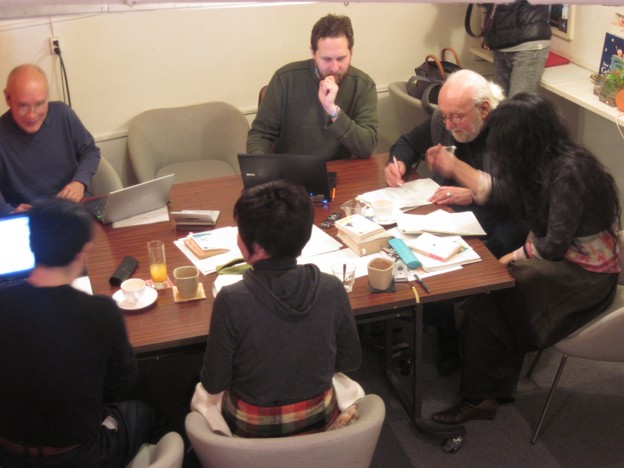
In March 2010, four prominent Japanese poets, Shuntarō Tanikawa, Hiromi Itō, Yasuhiro Yotsumoto and Wakako Kaku, plus the well-known American poet Jerome Rothenberg, met in the southern Japanese castle-town of Kumamoto for three days of writing renshi. The poets had gathered together from their homes in three nations – Japan, America, and Germany – and because they were writing in both Japanese and English, I also joined them as a translator to help render the poems and facilitate communication.(5) As the sabakite or ‘judge’ who would organise the progress of the renshi, Shuntarō Tanikawa set the rule that each poet could write up to ten lines per round, and he developed a system of rotation so that each poet would not follow any other poet more than twice during the course of the sequence.

Because all were eager to embark upon this project, the poets began exchanging verses via e-mail even before meeting. As a result, many of the earliest verses in the sequence are full of excited optimism about the prospect of coming to Kumamoto to write. Hiromi Itō started off the sequence with a four-line quotation from a local, sacred song preserved in the annual festival at the nearby Aso Shrine. These lines describe the singers’ eagerness to put their voices together in song – a fine introduction to a series of verses written by poets coming together from around the world. Shuntarō Tanikawa followed with a celebratory verse containing pastoral images children playing as visitor’s words flourish nearby. Jerome Rothenberg’s verse picked up on an image in Tanikawa’s verse of an underground world associated with the dead and linked it to the idea of sheol, the Jewish underworld.

Wakako Kaku’s verse, narrated from the point of view of one of the great primeval goddesses of the Kojiki (Record of Ancient Matters), continues the tone of welcome of the previous poems, but rather than an individual welcoming others, her narrator is a goddess whose body is a volcano, and she welcomes the destructive lava that flows through her. (Kumamoto is located nearby Mount Aso, an active volcano that still spews rocks and poison gas on a daily basis.) Leading on from this, Yasuhiro Yotsumoto took the image of flowing red and shifted perspective radically, writing about a woman who, fearing she was pregnant, welcomes the menstruation that she feels beginning as she watches a diorama of an erupting volcano in the Mount Aso museum. In this way, themes and images passed from poet to poet in the first round of poems as each one stepped out on stage, performed their own improvisational riff, and then stepped back again into the background to accompany the next person as they took the lead in directing the progress of the improvisation. By the time these five verses had been completed, the series of poems had arrived at a place that most likely none of the individual poets could have predicted at the outset.

Except for the first few verses, which were done by e-mail, most of the work was conducted in intense bursts of writing while sitting together in a coffee shop named Orange in Kumamoto. The process involved a great deal of consultation as we discussed the finer points of the poems, debated whether or not one verse was too close to another that followed, and considered potential translations for certain phrases. (On these matters, the sabakite, Shuntarō Tanikawa, had the final say.) Much like the renga sessions of old, which often involved bursts of creative output between delicious food, saké and baths in hot springs, we punctuated our writing with meals together, excursions to local sites and drinks in the evening. The result was an intense spirit of camaraderie and cooperation, especially as the days wore on and we had to begin working at an increasingly frenetic pace to finish the thirty verses we had agreed upon in advance.

Of the various approaches to writing, Itō’s was perhaps the most striking. Rather than penning her own original words for this project, all of her verses consisted of quotations, which she selected with deliberation and care. Her goal, she explained, was to try to find ways to use the voice of others to present her own – an intertextual move that introduced an additional element of collaboration within the renshi. In a brilliant metapoetic moment at the beginning of verse number 27, Yotsumoto humorously comments on Itō’s use of quotations, noting that although she relied upon quotations through to the very end, Itō had revealed her own individual personality through them, much as a shape-shifting tanuki accidentally reveals its tail.

After completing thirty verses, on 10 March, we gathered for a public reading of the poems in front of a packed auditorium. All of the seats had been sold out for over a mouth, the audience drawn by the impressive constellation of famous poets that had come to cooperate in the project. The spectators were rapt as we read our work and discussed the links between verses. One highlight of the performance came at the end of the presentation. In verse 13, Tanikawa had described a young actress who, after playing the role of a mute on stage, goes home singing. In verse 14, Yotsumoto had written the lyrics of the song he imagined her to be singing. Kaku is an accomplished musician and composer, and when she was not busy writing her own verses for the renshi, she volunteered to compose a song to accompany the lyrics. At the end of the reading, Kaku and Yotsumoto performed the song, she with her guitar and him singing for all he was worth. It was a rousing moment, and not surprisingly, the audience went wild, cheering for the great collaborative gift these poets had given them. Three cheers for renshi!


[N.B. Originally published in Poetry International Rotterdam 2010.  See also Jerome Rothenberg’s account, “A Round of Renshi” posted in three installments (2012) on Poems and Poetics.]

Tuesday, October 29, 2013

David-Baptiste Chirot: Cinema of Catharsis (I-III) Redux

for Rex Chirot & Jerome Rothenberg 
Preface: 

El Colonel is smiling, writing with his cigarette’s smoke in that great page, the sky . . . that great page, ever open to all, in which all eyes may read---and there, their readings being writings . . . find also the writings of others . . . moving, living, in skies of their own among these sometimes shared skies, these skies sometimes encountering each other . . . these writings, readings readers & writers . . . meeting among these skies . . . so that—

 So that—El Colonel has often wondered, often written his own “versions”—of his readings which are writings—of these phrases he found underlined in red among the black letterings of a fire-singed Bible in the basement of a bombed-out bookstore in a small provincial town high in the mountains . . . and which are:  “For now we see through a glass, darkly; but then face to face:  now I know in part; but then shall I know even as also I am known.”—for, had not El Colonel wondered—what, if, indeed, come face to face, that ‘I’ which became known as also it was known—what if indeed, that ’I’—were an Other . . . for had not he also read, among other books found elsewhere, among other demolished sites . . . had he not read that ‘I is an other’ . . . in which case, El Colonel writes with his cigarette in the sky’s pages . . . in which case might not the “I” be also known as an other . . . an other found continuously in this other that is his writing in the sky . . . a writing read by others . . . who in reading in their turn write . . .

I. 

El Colonel is smoking.  Writing in the skies, on the varying hues of blue that shift with their proximities to the horizon . . . writing on the clouds scattered carelessly about . . . his eyes like fingers move, inscribing texts often in no known languages, at times in ones he barely knows from tattered texts come across—languages foreign to him—and, at times, even in the two languages he knows well . . . writing in the skies essaying to convey the dream states that float among memories---involuntary memories called out by the random touching of a shadow at the foot of a tree on the ground next to him—events long forgotten vividly alive—

El Colonel is smoking.  These memories & dreams he is inscribing in the sky are not of large events at all. Thank God! No!—No, these are all the small events, happenings, that one is unaware for the most part that one is even noticing as they are passing—

II. 

In a room, in some other place, a city—somewhere—she is sitting, smoking, writing in her journal . . . some time ago she had begun to interpret her life in terms of events, of writings, of images, documents—come across in her continual perusal and construction of her own “Kennedy Collection”—comprised primarily of books and old magazines, but including also stacks of Xeroxes of fotos of the JFK Assassination, which she keeps for cutting up and rearranging—into collages—and these slowly through time finding their ways into various scrapbooks she keeps— 

This “Kennedy Collection” she periodically pours through, finding each time a differing sequence, a differing set of clues as to the “meanings” she is to interpret from them regarding her own existence. 

Increasingly, her own days are intercut, shot through, with those “Days in Dallas”—especially as Autumn advances, inexorably—to the annual return of That Day—among “Those Days”—yet not only “those Days”—but all the Days surrounding them through time—the entire lifetime especially of Lee Harvey Oswald dominates certain areas of her consciousness, including the continually growing storehouse of memories which she associates directly with the Life of Oswald. 

Thus, one October, during visits to her sister’s, she became aware that certain patterns in the linoleum were directly related with constellations which must have been embedded in the kitchen, say, of the houses where Marina Oswald had been living with, say, Ruth Paine—and others, perhaps also—where the Oswalds had lived after their New Life in America had begun--and these intersecting patterns and constellations found in linoleums were in fact reconstructions of some other events in consciousness, a consciousness greater than her own—indeed, one comprising, as it were, chunks of the Twentieth Century itself . . . even though now well into the Twenty-first century, she felt that these secrets exuded from expiring linoleums scattered through time and across the “interior landscapes of the late Twentieth Century” . . . yes—she distinctly, most definitely felt!—that these secrets being exuded had traversed the “line between Centuries,” as though transgressing a forbidden, or, at least—forbidding-- border—not unlike, say the border that Oswald crossed from Finland into the Soviet Union during his “defection”---yes!-- she felt, she distinctly felt-- these “secrets” had been, were continually—seeping, invading surreptitiously, as though entering in as soldiers do in moving through ground brush, on their bellies . . . that these secrets were arriving, day by day, night by night, at the very entrance to the battered small house she lived in on a battered small side street in a battered small section of the battered small city which she envisioned always as the one sacred place where these rites could take place, observed and participated in only by herself, their one initiate . . . 

One October Sunday . . . as the late afternoon golden glow began to fade from the hallucinatory reds, oranges, dark greens and near-blacks of the heavy leaves—as the first shadows of the suddenly much cooler twilight began to etch their ways across the small battered lawn . . . one October Sunday, she indeed felt more strongly than ever the presence of the seeping secrets exuded by the linoleums of those kitchens Lee Harvey Oswald had entered in, in visiting with his estranged wife and children . . . she felt that these secrets were unfolding before her very eyes there on the shadow etched small battered lawn . . . sounds were reaching her from a neighbor’s TV—set to the NFL football games . . . Oswald she remembered had watched football during his last visits with his family . . . (more likely college football, on Saturdays? . . . some part of her mind registered the question—hanging there in the air—have to look it up, some part of her mind muttered, making a mental note of it—almost certain of it—were after all the pro games on then, before there was more than just the one then much smaller pro league . . . ? an important detail to come back to--)—yes—Oswald had watched football games . . . her eyes moved among the patterns etched by the twilight shadows on the small battered lawn, seeing in them the slow emergence of patterns seeping in from those long ago linoleums . . . as though the “action” of the plans gathering in Oswald’s mind—whether his own or those being planned and planted there by others---as though the action now was moving outdoors . . . from out of those rooms in the cheaply furnished homes, those flimsily constructed rooming houses he moved among . . . was moving outdoors and there, in the gathering twilight, taking form, gathering its thoughts as it were, in the patterns emerging—the very same patterns that had been observed in the linoleum—she now saw quite distinctly etched there, there in the backyard, on the small battered lawn . . .  

 III. 

El Colonel is smoking . . . from the stream of involuntary memories which he is writing in the sky with his eyes . . . begin to emerge, at first in clusters, closely clumped, tightly gathered—begin to emerge small constellations of images, images each so sharp, so clearly distinct, that its facets, diamond-like, begin to etch into, cut open, the adjacent images in the constellation---releasing sudden erupting streams—like those lone spraying spumes suddenly sliced open and squirting forth from the sun---those long trails of raging, burning, appallingly beautiful reds and oranges . . . blasting into space---pure Heraclitean fires . . . of being---Being released into the infinite of Space---traveling with such incredible storm-powered speeds that they seem to scream into the eyes . . . and out of these searing images . . . as though they are cooling in an acceleration of “the evolution of Time” —out of these released images emerge suddenly, in single file, as though a slide show being shown in the skies—images, images long forgotten—no longer singular images, but ones which open up—as the mouths of caves are said to open—and reveal within them depths . . .  

El Colonel is smoking . . . leaning, leaning into the slight breezes which are now coming up over the edges of the hill . . . leaning the better to see—to see within this opening now so vividly before him— 

It is a cinema, its entrance like a cave mouth—embedded in a seeming cliff, which is in actuality as its image becomes more distinct to the hard-peering eyes of El Colonel—which is in actuality the tightly spaced wall of a series of buildings on a street he had once found in a bombed out small city . . . it came to him now in a howling rush of clarity—the entrance to this Cinema of Catharsis as he had thought of it, even before entering into it and finding himself, first, in a lobby entrance, a very long, extended hallway—at the end of which was the glass enclosed small booth where a ticket taker would be standing when a show was in progress—at the start of shows, also—and at all times in between—time now heaving and buckling, in time with the heaving and buckling of the parquet floor of the long hallway leading to the interior entrance where the ticket taker’s booth was standing . . .a heaving and buckling which, nonetheless, did nothing to disturb the immense lobby card images hanging on the roughly painted walls of the long hall of the lobby . . . these images, each one of them belonging apparently to completely different films—gave evidence of the long history of this particular Cinema—as some of them dated back to the era of Silent Films—while others showed more recent productions—most of them cheap B jobs . . . El Colonel finds himself, via the intensity of his gaze, “entering into” the area beyond the ticket taker’s booth— 

El Colonel’s figure, leaning into the breezes, leaning into the sky—looks for all the world to those eyes outside himself which he often finds looking at himself—from himself—his own eyes, detached, as it were—and located at some distance—find his leaning figure for all the world to look like some shadow figure, a silhouetted shadow puppet on a wall of infinite space---a wall of pale depths . . .  

El Colonel is smiling to himself, smiling as he enters into the area beyond the ticket taker’s booth—an area where the once red plush rug is now worn thread bare—literally thread bare, El Colonel finds himself smiling to himself, smiling to find the time worn phrase, itself not a bit “threadbare”—to be in actuality, there before him, the most vivid illustration he has ever found of that thread bare phrase—and, on this thread bare surface, are scattered the kernels of long ago pop corn, the ashes of ancient cigarettes, the air still redolent with the scents of both—the heavy clinging haze of the popcorn smells intermingled with the ashy tastes, acrid and acrimonious, of the cigarette ashes held in suspension among the interstices of the threadbare rug . . . 

El Colonel smiles, and, pushing on, as he smilingly puts it to himself:  “as his actions, reversing Aristotelian Poetics, imitate the words—push on”—pushing through the heavily covered door that opens somewhat unwillingly into the Cinema itself . . . before entering, El Colonel’s eyes take in this dim lit arena—picking out the shadowy tops of the lines of the seats—here and there, like rows of broken teeth—betraying the presence of seats which, due to the excited or angry gestures of some patron, dim, jerky, faraway—some patron’s having pounded on them, beaten them, into a kind of slouching submission—so that the rows of seats are broken up by these gaps, these craggy monuments of remaining teeth-like chairs—jagged and raw—their blank spaces staring at the Cinema screen—gaping from their gaps into the as yet dim presence looming there in the shadows at some distance from El Colonel, who remains for some moments standing at the entrance . . .


NOTE. Concerning the whole El Colonel series, an evolving “major” work, Chirot, whose work, both verbal &  visual, is a great too often hidden resource, has written elsewhere: “it should be noted that El Colonel is not a ‘static’ being—moves through & inbetween as ‘in-beat-we-in’—is rhizomatic—rhythmic—unfolding—in events among Time & ‘consciousnesses’—non-linear-and ‘occurs’ not so much as a ‘character’ ‘by an author’(including himself)---but exists in dimensions which begin to explore the zones which Stephane Mallarme created as ‘poèmes critiques’—& an obsession with El Colonel is a Writing which exists without ‘materializing’—a Journey with the Writing of the No—“there is thus no particular ‘order’ to the pieces, though the ‘first’ appearance as and in print of El Colonel is the Chapbook ‘El Colonel Smiles’—(also published as a prose poem text w/o images in Otoliths online & print Journal-)—the first presentation of El Colonel’s ‘thoughts, those improvised compositions’ which may serve as a kind of ‘Intro’ in re ‘composition’& re composition as an emergence out of ‘decomposition’--appears in ‘El Ojo de Dios Part the First: Insects & Letters,’ which can be linked to at the Sous Rature site.”

An extensive bibliography of Chirot’s published El Colonel pieces can be found on his blog at http://davidbaptistechirot.blogspot.com/2010/11/chirot-el-colonel-emerges-bibliography.htmlhttp://davidbaptistechirot.blogspot.com/2010/11/chirot-el-colonel-emerges-bibliography.html


Saturday, December 3, 2011

Protecting Wirikuta: A Petition to the President of Mexico


GRUPO DE LOS CIEN INTERNACIONAL / GROUP OF 100
December 1, 2011

WRITERS AND ARTISTS ASK MEXICO’S PRESIDENT TO CANCEL MINING CONCESSIONS IN THE SACRED TERRITORY OF THE HUICHOL PEOPLE

     Mexico may be the world’s largest silver producing country, but not all that shines is silver. Countries also shine in their myths and rites, their traditions and culture, and the Huichol (or Wixáritari, in their own language) have shone in Mexico and the world by preserving their unique spiritual identity over time.  The annual pilgrimage made by the Wixáritari across the sacred desert landscape of Wirikuta to Cerro Quemado, the mountain where they believe the sun was born, is internationally famous.
     In November 2009 the Canadian mining company First Majestic Silver bought 22 mining concessions in the Real de Catorce area, in the state of San Luis Potosi.  These concessions will allow First Majestic Silver to carry out what the company describes as “an aggressive drilling and exploration program” on 6,327 hectares of land.
     The problem is that this part of San Luis Potosi lies in the middle of the Wirikuta Natural Reserve. For centuries Huichol men, women and children have made their way here from communities in the western Sierra Madre mountains in the states of Jalisco, Nayarit, Durango and Zacatecas to carry out their religious ceremonies, accompanied and guided by the mara’akate, their shaman-priests.
     Handing over the sacred territory of the Huichols to First Majestic Silver to be mined for its own financial gain not only betrays the colonial mentality of the politicians and bureaucrats responsible for selling silver, Mexico’s most emblematic mineral resource, to foreign companies but, far worse, will entail the desecration of the ancestral lands of the Wixáritari.
     First Majestic Silver operates exclusively in Mexico, at its La Parrilla, San Martin and La Encantada mines, and expects to produce seven and a half million ounces of silver in Mexico during 2011.
     Minera Golodrina, a Mexican subsidiary of the Canadian-based multinational Lake Shore Gold Corp, plans to dig an open-pit gold mine in the sacrosanct core zone of the Wirikuta Reserve, extracting gold using the highly toxic cyanide process. Both mining operations would endanger the scarce local water supply.
     When many people speak of a Mexico that is greater and more enduring than the current climate of violence, they are thinking of its history and culture, and mention of Wirikuta brings to mind an ethnic group which is profoundly Mexican and respected the world over for its authenticity and creativity, whereas mention of First Majestic Silver and Lake Shore Gold Corp brings to mind rapacity and colonialism.
     We ask President Felipe Calderón --- who witnessed the signing of the Huaxa Manaka Pact three years ago by the governors of five states who vowed to preserve the sacred territory of the Wixárika people --- to cancel the mining concessions granted to both Canadian companies.  We hope that President Calderón will not go down in history as the man who authorized the destruction of Wirikuta and its holy ceremonial sites.

SIGNED BY:

MExico: Homero Aridjis, Elena Poniatowska, Francisco Toledo, Gabriel Orozco, Jean Meyer, Nicolás Echevarría, Juan Villoro, Rubén Gallo, Manuel Felguérez, Gilberto Aceves Navarro, Lydia Cacho, Jorge Zepeda Patterson, Coral Bracho, Bárbara Jacobs, Vicente Rojo, Gabriel Weisz, Ana Pellicer, Roger von Gunten, Chloe Aridjis, Eva Aridjis, Laureana Toledo, Miguel Calderón, Rogelio Cuéllar, Javier Aranda, Guillermo Fadanelli,  Tedi López Mills, Elsa Cross, Beatriz Rojas, Pablo Meyer, Marina Meyer, Matías Meyer, Jerónimo López/ Dr. Lakra, Abraham Cruzvillegas, Damián Ortega, Rosa Velasco, Gabriel Kuri, Ximena Cuevas, Eduardo Hurtado, Yoshua Okón, José Luis Paredes Pacho, Monica Manzutto, José Kuri, Isadora Hastings García, Natalia Toledo, Federico Campbell

FRANCE:  Yves Bonnefoy, J. M. G. Le Clézio, Jean-Clarence Lambert, Gérard Titus-Carmel, Georgiana Colville, Pascale Montandon

SWEDEN: Tomas Tranströmer, Kjell Espmark, Per Wästberg, Lasse Söderberg

TurKEY:  Orhan Pamuk

UNITED STATES:  Lawrence Ferlinghetti, Paul Auster, Peter Matthiessen, Rita Dove, Junot Díaz (& Dominican Republic), Siri Hustvedt, Nicole Krauss,  Jonathan Safran Foer,  Robert Darnton, Michael Scammell, Edward Hirsch,  Pete Hamill, Tom Hayden, Jerome Rothenberg, Terry Tempest Williams,  Francisco Goldman, Bill McKibben, Deirdre Bair, Francine Prose, Molly Moore, Eliot Weinberger, Robert Hass, Kwame Anthony Appiah, Ross Gelbspan, Robert Glenn Ketchum, Dr. Lincoln Brower, Betty Aridjis, Michael Palmer, Clayton Eshleman, Askold Melnyczuk, Amory Lovins, Charles Bernstein, Alan Weisman,  Amy Evans McClure, Michael McClure, Anthony DePalma, Grace Schulman, Scott Slovic,  Serge Dedina,  Dick Russell, Eric Lax, Edmund Keeley, Mimi Gross, A. E.  Stallings, James Metcalf (& Mexico), Ilan Stavans (& USA), Janet Brody Esser, Elizabeth Ferber

CANADA:  Margaret Atwood, Michael Ondaatje, John Ralston Saul,  Linda Spalding, Graeme Gibson, Terence Gower, George McWhirter  (& Northern Ireland)

UNITED KINGDOM: Simon Schama, Jonathon Porritt, Ali Smith, Simon Winchester, Alan Riding, Anne Stevenson,  Darian Leader, Lisa Appignanesi,  Cornelia Parker, Rosie Boycott,  Michael Schmidt, Mary Horlock, James Lasdun, Ruth Fainlight, Anthony Rudolf, Devorah Baum, Josh Appignanesi

BELGIUM:  Pierre Alechinsky, Ivan Alechine, Wim Delvoye

NIGERIA: Chinua Achebe

CHILE: Alejandro Jodorowsky, Ariel Dorfman, José María Memet 

RUMANIA: Norman Manea  (& USA)

SPAIN: Carlos Garcia Gual, Frederic Amat

CUBA: Zoé Valdés (& France)

INDIA: Kiran Desai, Meena Alexander

SOUTH AFRICA: Breyten Breytenbach

COLOMBIA: Fernando Rendón, Cecilia Balcazar, Angela García

NORWAY: Eugene Schoulgin

THE NETHERLANDS: Laurens van Krevelen

CYPRUS: Lily Michaelides, Niki Marangou, Christos Hadjipapas

ITALY: Giuseppe Bellini, Sebastiano Grasso, Patrizia Spinato, Franca Tiberto

NICARAGUA:  Sergio Ramírez, Francisco de Asís Fernández

PanamA: Gloria Guardia (& Nicaragua)

Japan: Satoko Tamura

MAURITIUS: Ananda Devi
 
BRAZIL: Ledo Ivo

URUGUAY: Carlos Fazio (& Mexico)

GREECE: Vassilis Vassilikos, Anastassis Vistonitis, Ersi Sotiropoulos, Dino Siotis, Yorgos Rouvalis

AUSTRIA: Peter Stephan Jungk (& USA)

GERMANY: Helga von Kügelgen, Kropfinger, Fred Viebahn, Tobías Burghardt, Jona Burghardt

Bangladesh: Hasna Jasimuddin Moudud

ARGENTINA: Octavio Prenz 

SLOVENIA: Tomas Salamun, Gregor Podlogar